SPACECRAFT AND FLIGHT HARDWARE
Space X currently manufactures two broad classes of rocket engine in-house: the kerosene fueled Merlin engines and the hypergolic fueled Draco/Super Draco vernier thrusters. The Merlin powers their two main space launch vehicles: the large Falcon 9, and the super-heavy class Falcon Heavy. Space X also manufactures the Dragon, a pressurized orbital spacecraft that is launched on top of a Falcon 9 booster to carry cargo to low Earth orbit, and the follow-on Dragon 2 spacecraft, currently in the process of being human-rated through a variety of design reviews and flight tests.
ROCKET ENGINES
Since the founding of Space X in 2002, the company has developed three families of rocket engines — Merlin and Kestrel for launch vehicle propulsion, and the Draco control thrusters. Space X is currently developing two further rocket engines: Super Draco and Raptor.
Merlin is a family of rocket engines developed by Space X for use on its Falcon rocket family of launch vehicles.
Kestrel is a LOX/RP-1 pressure-fed rocket engine, and was used as the Falcon 1 rocket's second stage main engine.
Draco are hypergolic liquid-propellant rocket engines that utilize monomethyl hydrazine fuel and nitrogen tetroxide oxidizer. Each Draco thruster generates 400 newtons (90 lbf) of thrust. They are used as reaction control system (RCS) thrusters on the Dragon spacecraft.
Raptor is a new family of methane-fueled full flow staged combustion cycle engines to be used in its future Interplanetary Transport System. Development versions have been test fired.
FALCON LAUNCH VEHICLES
Since 2010, Space X has flown all its missions on the Falcon 9. They are also actively developing the Falcon Heavy, and previously developed and flew the Falcon 1 pathfinder vehicle.
Falcon 1 was a small rocket capable of placing several hundred kilograms into low earth orbit. It functioned as an early test-bed for developing concepts and components for the larger Falcon 9. Falcon 1 attempted five flights between 2006 and 2009. On September 28, 2008, on its fourth attempt, the Falcon 1 successfully reached orbit, becoming the first privately funded, liquid-fueled rocket to do so.
Falcon 9 is an EELV-class medium-lift vehicle capable of delivering up to 22,800 kilograms (50,265 lb) to orbit, and is intended to compete with the Delta IV and the Atlas V rockets, as well as other launch providers around the world.
In 2011, Space X began development of the Falcon Heavy, a heavy-lift rocket configured using a cluster of three Falcon 9 first stage cores with a total 27 Merlin 1D engines and propellant crossfeed. When Space X finishes development and the rocket is launched, the Falcon Heavy will be the world's most powerful rocket in operation. Space X is aiming for the first demonstration flight of the Falcon Heavy in November 2017.
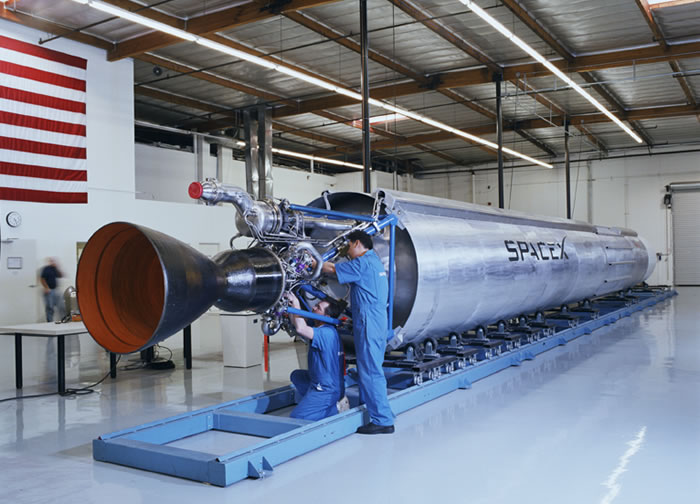
The Falcon 1 prototype at SpaceX's assembly facilities.
| FOLLOW SPACEX | YOUTUBE | FLICKER | © 2018 SPACE EXPLORATION TECHNOLOGIES CORP. |