FUNDING
SpaceX is privately funded.It developed its first launch vehicle-Falcon 1-and three rocket engines-Merlin, Kestrel, and Draco-completely with private capital. SpaceX contracted with the US government for a portion of the development funding for the Falcon 9 launch vehicle, which uses a modified version of the Merlin rocket engine.SpaceX is developing the Falcon Heavy launch vehicle,the Raptor methane-fueled rocket engine,and a set of reusable launch vehicle technologies with private capital.
In August 2012, SpaceX signed a large development contract with NASA to design and develop a crew-carrying space capsule for the "next generation of U.S. human spaceflight capabilities", in order to re-enable the launch of astronauts from U.S. soil by 2017. Two other companies, Boeing and Sierra Nevada Corporation, received similar development contracts. Advances made by all three companies under Space Act Agreements through NASA's Commercial Crew Integrated Capability (CCiCap) initiative are intended to ultimately lead to the availability of commercial human spaceflight services for both government and commercial customers. As part of this agreement, SpaceX was awarded a contract worth up to $440 million for contract deliverables between 2012 and May 2014.
At the end of 2012 SpaceX had over 40 launches on its manifest, representing about $4 billion in contract revenue. Many of those contracts were already making progress payments to SpaceX, with both commercial and government (NASA/DOD) customers.As of December 2013, SpaceX has a total of 50 future launches under contract, two-thirds of them are for commercial customers.In late 2013, space industry media began to comment on the phenomenon that SpaceX prices are undercutting the major competitors in the commercial commsat launch market—the Ariane 5 and Proton-M[—at which time SpaceX had at least 10 further geostationary orbit flights on its books.
In January 2015 SpaceX raised $1 billion in funding from Google and Fidelity, in exchange for 8.333% of the company, establishing the company valuation at approximately $12 billion. Google and Fidelity joined the then current investorship group of Draper Fisher Jurvetson, Founders Fund, Valor Equity Partners and Capricorn.
NASA CONTRACTS
COTS
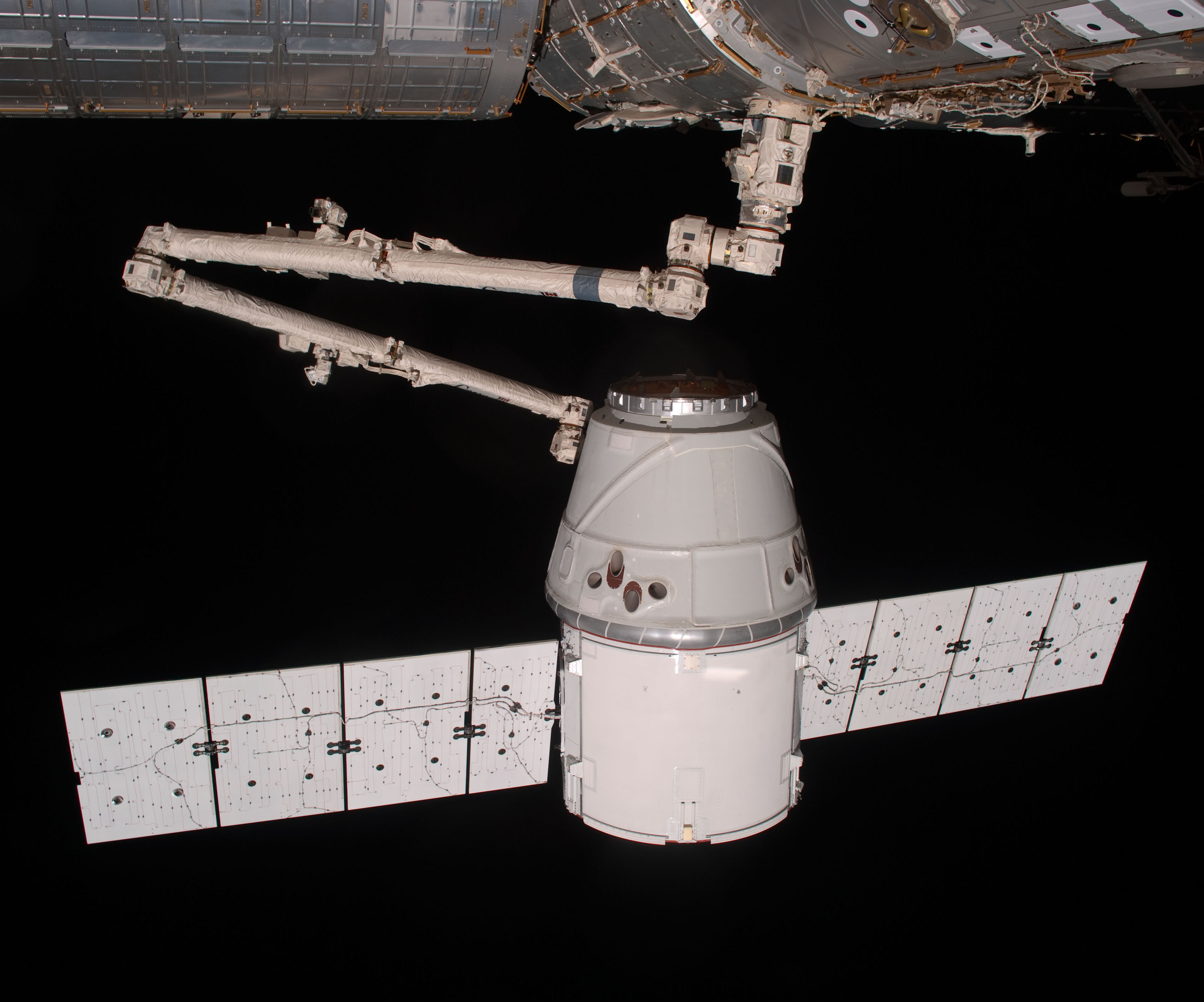
In 2006, NASA announced that SpaceX had won a NASA Commercial Orbital Transportation Services (COTS) contract to demonstrate cargo delivery to the ISS, with a possible option for crew transport.This contract, designed by NASA to provide "seed money" for developing new boosters, paid SpaceX $278 million to develop the Falcon 9.In December 2010, the launch of the COTS Demo Flight 1 mission, SpaceX became the first privately funded company to successfully launch, orbit and recover a spacecraft.Dragon was successfully deployed into orbit, circled the Earth twice, and then made a controlled re-entry burn for a splashdown in the Pacific Ocean.With Dragon's safe recovery, SpaceX became the first private company to launch, orbit, and recover a spacecraft; prior to this mission, only government agencies had been able to recover orbital spacecraft.COTS Demo Flight 2 launched in May 2012, in which Dragon successfully berthed with the ISS, marking the first time that a private spacecraft had accomplished this feat.
The COTS 2 Dragon is berthed to the ISS by Canadarm2.
| FOLLOW SPACEX | YOUTUBE | FLICKER | © 2018 SPACE EXPLORATION TECHNOLOGIES CORP. |